


Rolex Four Seasons Daytonas Sell for $49.4 Million at Phillips
Rolex's four one-of-a-kind gem-set Cosmograph Daytonas sold for a combined $49.4 million (£37.3 million) at Phillips in London on 28 September 2026, per Hodinkee. Summer, the Everose piece with the turquoise dial, was the top lot at $13.65 million. Autumn brought $13.5 million, Winter $13.2 million and Spring $9 million. Every dollar goes to the Federer Foundation and Re:wild. Hodinkee reports the set was originally meant to sell as a single retail box set for roughly CHF 4 million, so the room paid about ten times that.
Last updated: September 28, 2026 (auction results added)
Table of Contents
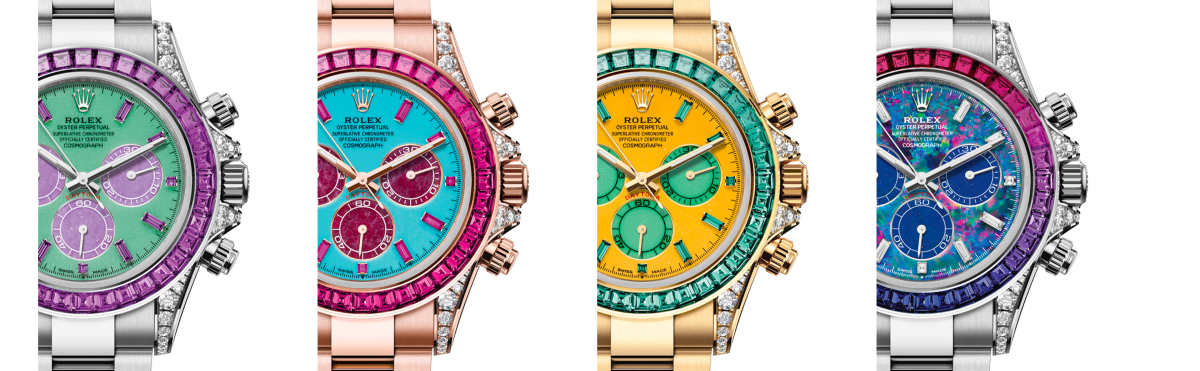
The full set, left to right: Spring, Summer, Autumn, Winter. Image: Rolex
The Results, Lot by Lot
Aurel Bacs took the sale for Phillips, which billed it as Rolex's first charity auction. The four watches went as four separate lots. Here is what each one brought.
| Season | Case Metal | Dial | Sold For (USD) | Sold For (GBP) |
|---|---|---|---|---|
| Summer | 18 ct Everose gold | Turquoise | $13.65 million | £10.3 million |
| Autumn | 18 ct yellow gold | Mookaite | $13.5 million | £10.2 million |
| Winter | 950 platinum | Blue opal | $13.2 million | £10.0 million |
| Spring | 18 ct white gold | Chrysoprase | $9.0 million | £6.8 million |
| Total | $49.4 million | £37.3 million |
Results as reported by Hodinkee on 28 September 2026. Sorted highest to lowest.
A few things jump out. Three of the four landed within half a million dollars of each other, which tells you the bidding was about owning one of these, not about which metal or stone was "best." Spring was the outlier at $9 million, which is still a remarkable number for a Daytona.
For scale: the original 1994 Rainbow Daytona made about $6.3 million at Phillips in November 2024, and every Four Seasons lot cleared that. Paul Newman's own Daytona, sold at Phillips in New York in 2017 for $17.75 million, is still the single most expensive Daytona. None of the four individually touched it. Together, they came to nearly three times that number.
What Rolex Sold
Four Oyster Perpetual Cosmograph Daytonas, built as one-of-one pieces, each one themed to a season. Spring is white gold. Summer is Everose. Autumn is yellow gold. Winter is 950 platinum. Every one of them has a dial cut from natural stone, a bezel set with colored gemstones, and diamonds on the lugs and crown guard.
Phillips ran the sale on 28 September 2026 in London, at a gala dinner rather than a standard saleroom session. The four watches were offered individually, so a buyer could take one season without committing to all four. Per SJX, the set was shown quietly at Watches & Wonders 2026 before the public announcement on 3 September.
Rolex and Phillips never published pre-sale estimates. The only price anyone had was the original one: Hodinkee reported that Rolex first planned to sell the four as one boxed set through its retailers, at roughly CHF 4 million for all four, and that more than 1,000 names were rumored to have been submitted for it. Rolex moved it to auction instead.
The Four Watches, Season by Season
All four share the same lug and crown-guard treatment: 54 brilliant-cut diamonds, roughly 0.86 carats, per Rolex. Everything else changes. Here is how the four break down.
| Season | Case Metal | Bezel | Dial Stone | Counters |
|---|---|---|---|---|
| Spring | 18 ct white gold | 36 trapeze-cut purple sapphires (approx. 5.57 ct) | Chrysoprase | Lepidolite |
| Summer | 18 ct Everose gold | 36 trapeze-cut pink sapphires (approx. 4.32 ct) | Turquoise | Heart of ruby |
| Autumn | 18 ct yellow gold | 36 trapeze-cut green tourmalines (approx. 4.32 ct) | Mookaite | Chrysoprase |
| Winter | 950 platinum | 36 trapeze-cut sapphires, blue to fuchsia gradient | Blue opal | Lapis lazuli |
Specifications per Rolex. "Heart of ruby" and "counters" are Rolex's own terms; counters are the chronograph sub-dials.
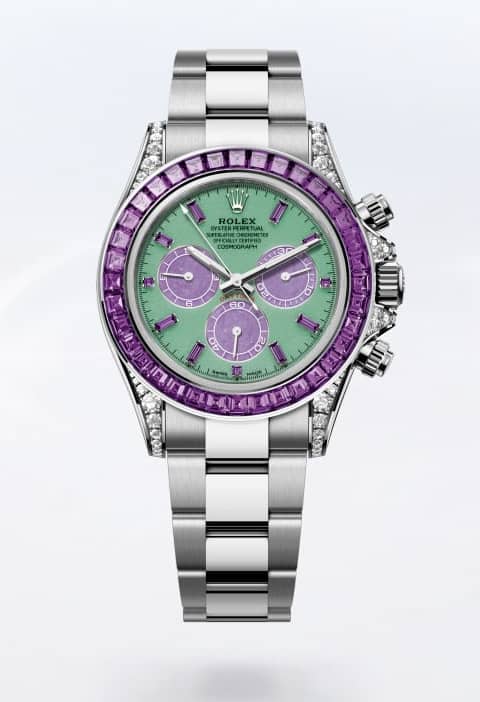
Spring: 18 ct white gold, 36 trapeze-cut purple sapphires, chrysoprase dial with lepidolite counters. Image: Rolex
Spring: White Gold and Purple Sapphires
Chrysoprase gives Spring a soft, opaque green dial, and the lepidolite counters come back at it in lilac. The bezel is 36 trapeze-cut purple sapphires at roughly 5.57 carats, the heaviest carat weight Rolex published for the set. Hour markers are eight baguette-cut and three square-cut purple sapphires in white gold settings. It is the most tonally aggressive of the set, green against purple, and it is the one that reads most clearly as a color exercise rather than a jewelry piece.
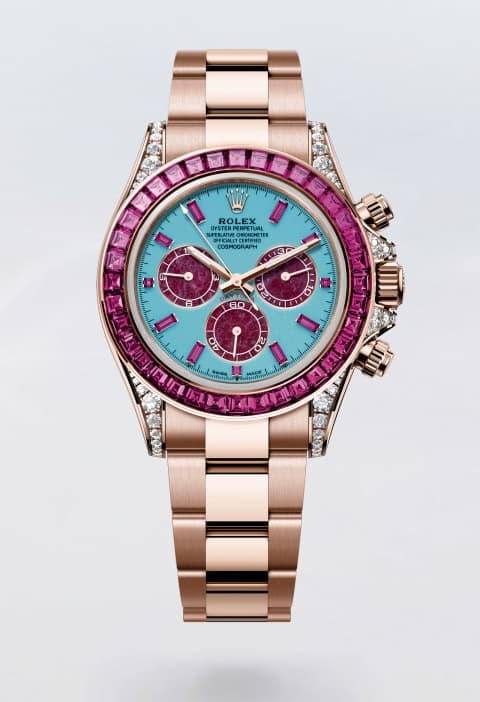
Summer: 18 ct Everose gold, 36 trapeze-cut pink sapphires, turquoise dial with ruby counters. Image: Rolex
Summer: Everose and Turquoise
Turquoise dial, ruby counters, pink sapphire bezel, Everose case. Rolex has done turquoise dials on the Daytona before. Pairing one with a full pink sapphire bezel and Everose is a combination we have not seen come through the secondary market. Everose is Rolex's own rose gold alloy with a small platinum content, which is what keeps the color from fading over the years. Before the sale we said this was the one that would photograph best and draw the most bidding attention on the night. It was the top lot at $13.65 million.
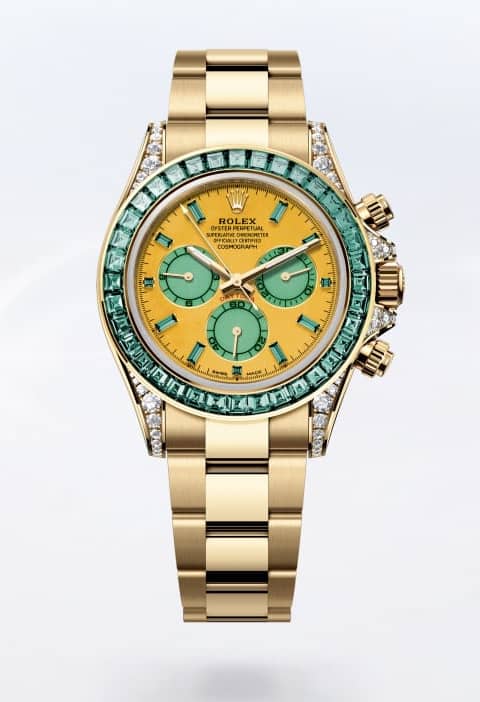
Autumn: 18 ct yellow gold, 36 trapeze-cut green tourmalines, mookaite dial with chrysoprase counters. Image: Rolex
Autumn: Yellow Gold and Tourmaline
Mookaite is a jasper, and the piece Rolex selected here runs a deep golden yellow, which is where the Autumn theme comes from. The counters are chrysoprase, so you get the same green that carries the Spring dial, used as an accent instead. The bezel is 36 trapeze-cut green tourmalines at roughly 4.32 carats. Green tourmaline shifts noticeably depending on the angle you view it from, so this bezel does something in person that a product photo cannot show.
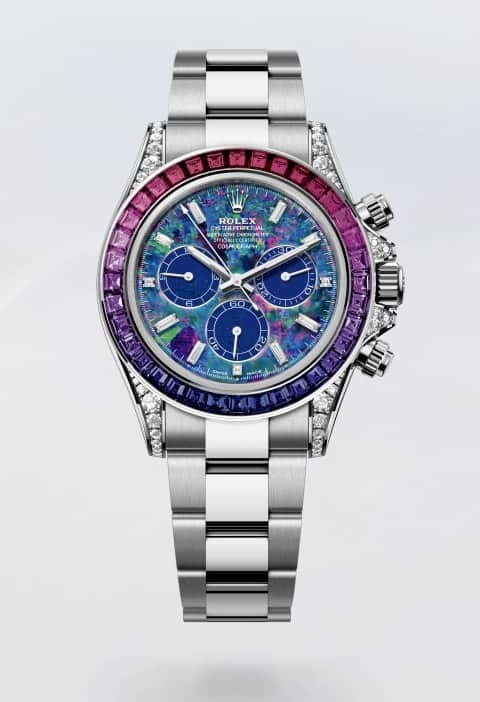
Winter: 950 platinum, 36 trapeze-cut sapphires in a blue-to-fuchsia gradient, blue opal dial with lapis lazuli counters. Image: Rolex
Winter: Platinum and Opal
Our pick before the sale. 950 platinum case, a dial cut from blue opal, lapis lazuli counters, and a bezel of 36 trapeze-cut sapphires graduating from blue through to fuchsia. Unlike the other three, the hour markers here are diamonds, eight baguette-cut and three square-cut, set in white gold. Opal is difficult to work with and difficult to match, and no two opal dials look quite the same under light. Platinum is also the metal Rolex reserves for its most serious Daytonas, so we read it as the centerpiece. The room didn't quite agree: Winter sold third, at $13.2 million, a few hundred thousand behind Summer and Autumn.
The Reference Numbers
Rolex identifies these watches by season in its auction announcement. The references circulating in the trade are 126599SAVL for Spring, 126595SARO for Summer, 126598TML for Autumn, and 126596SABV for Winter. Those line up cleanly with how Rolex numbers gem-set Daytonas, where the base reference indicates the metal and the suffix indicates the stone. 126595 is the Everose gem-set Daytona family, 126596 the platinum, 126598 the yellow gold, 126599 the white gold. Rolex's own materials still identify the watches by season only, so treat the references as reported rather than confirmed by Rolex.
Why This Is Unusual for Rolex
Two things stand out to us. The first is that Rolex was the seller. Rolex watches go through auction houses constantly, but almost always from private owners, estates, or dealers. Phillips billed this as Rolex's first charity auction, and we cannot recall Rolex consigning its own new production directly at anything like this scale.
The second is what these watches are. Gem-set Daytonas at this level are not stock you order. They are allocated quietly to long-standing clients of the brand's biggest boutiques, they are not listed on rolex.com, and Rolex does not discuss them publicly. We work the secondary market for exactly these pieces, and getting a factory gem-set Daytona is about as hard as it gets in Rolex. An open auction with a published date, and now a public price on every lot, is the opposite of how these normally move.
What This Means for Gem-Set Daytona Prices
We are not financial advisors, and what follows is speculation based on what we see in this market every day, not investment advice.
Before this sale, the benchmark for a gem-set Daytona at auction was the original 1994 Rainbow Daytona, reference 16599SAAEC, which Phillips sold in Geneva in November 2024 for CHF 5.5 million, about US$6.3 million, against an estimate of around $3.5 million. Phillips called it an auction record for an automatic Daytona. The Four Seasons lots beat that by anywhere from $2.7 million to more than $7 million each.
Those are unique pieces, sold by Rolex itself, with charity money attached. They don't reprice a production gem-set Daytona overnight. What they do is put a public number on a category that usually trades privately. For comparison, here is what factory gem-set Daytonas that are not unique cost today, from our own inventory:
| Reference | Description | Our Price |
|---|---|---|
| 116595RBOW | Everose "Rainbow", diamond-paved dial and bracelet | $670,000 |
| 126595RBOW | Everose "Rainbow", current reference | Price on Request |
| 116595RBOW | Everose "Rainbow", diamond-paved dial, polished bracelet | $448,000 |
| 126555TBR | Everose, giraffe diamond dial, diamond bezel | $260,000 |
| 126576TBR | Platinum, diamond bezel, ice blue dial | $245,000 |
| 126595TBR | Everose, diamond lugs and bezel, sundust dial | $200,000 |
| 126579RBR | White gold, diamond bezel, black-and-white mother-of-pearl dial | $95,000 |
| 116588TBR | "Eye of the Tiger", yellow gold | Price on Request |
WatchesOff5th pricing as of September 28, 2026. All pre-owned or unworn, available now. References are linked to their live listings.
All of those are listed and available pre-owned. Before the sale we wrote that we would not be surprised to see the platinum Winter piece clear seven figures, and that we would not bet against all four doing it. We undershot. The lowest lot of the night was $9 million, and the other three each cleared $13 million.


Where the Money Goes
All $49.4 million is split evenly between two organizations. The Federer Foundation, founded by Roger Federer in 2003, funds children's education programs in southern Africa and Switzerland. Re:wild was launched by a group of conservation scientists together with Leonardo DiCaprio and works on wildlife and habitat protection. Both Federer and DiCaprio have long-running relationships with Rolex, which is presumably how the two causes ended up sharing one sale.
Our Take
Every gem-set Daytona is its own thing, and what pulls someone toward one of these over another comes down to what clicks. We would still take the Winter piece. Platinum and opal is a combination Rolex has flirted with and never committed to like this, and the graduated sapphire bezel is the most technically difficult part of the whole set to execute. The room liked Summer a little more, and $450,000 on a $13 million watch is not much of a disagreement.
The bigger story is the gap between the original price and the result. Rolex planned to sell these four for roughly CHF 4 million. They brought $49.4 million. That is what happens when something Rolex makes only once goes to an open room instead of a quiet allocation. The Geneva sales start again in early November, and these four numbers are what every gem-set Daytona will be measured against going in, including the ones we buy and sell.
If you want a factory gem-set Daytona without waiting on a boutique allocation, that is the market we work in every day.
Frequently Asked Questions
How much did the Rolex Four Seasons Daytonas sell for?
A combined $49.4 million (£37.3 million) at Phillips in London on 28 September 2026, per Hodinkee. Summer sold for $13.65 million, Autumn $13.5 million, Winter $13.2 million and Spring $9 million. The four were offered as separate lots, and all proceeds go to the Federer Foundation and Re:wild.
Is a Four Seasons Daytona the most expensive Daytona ever sold?
No. Paul Newman's own Daytona still holds that spot at $17.75 million, sold at Phillips in 2017. The top Four Seasons lot, Summer, reached $13.65 million. All four did beat the $6.3 million the original 1994 Rainbow Daytona brought at Phillips in 2024, which Phillips called an auction record for an automatic Daytona at the time.
Can I still buy one of these Daytonas?
Not from Rolex. Each was a single piece, and all four sold at the 28 September auction. The only way one comes back to market is if its new owner decides to sell. If you want a factory gem-set Daytona now, production references like the Rainbow trade on the pre-owned market.
What are the Four Seasons Daytona reference numbers?
Reported in the trade as 126599SAVL (Spring, white gold), 126595SARO (Summer, Everose), 126598TML (Autumn, yellow gold) and 126596SABV (Winter, platinum). Rolex's own announcement identifies the watches by season only, so treat these references as reported rather than confirmed by Rolex.
Who benefits from the sale?
All $49.4 million is split evenly between the Federer Foundation, which funds children's education in southern Africa and Switzerland, and Re:wild, the conservation organization launched by conservation scientists with Leonardo DiCaprio.
Does Rolex normally sell watches at auction?
Rarely. Rolex watches appear at auction constantly, but almost always consigned by private owners, estates or dealers. Phillips billed this as Rolex's first charity auction. Rolex consigning four pieces of its own new production directly is the unusual part of this story.
Sources and Methodology
Sale results in US dollars and pounds are as reported by Hodinkee on 28 September 2026. The sale was a private charity event, and as of this writing neither Phillips nor Rolex has said whether the figures include a buyer's premium; the original roughly CHF 4 million set price and the rumored 1,000-plus interested names are from Hodinkee's 3 September reporting. The Paul Newman Daytona result is from Phillips. Watch specifications, the auction date, the auction house and the charity split come from Rolex's own one-of-a-kind auction page. Additional reporting on the Watches & Wonders 2026 preview and the individual-lot structure comes from Hodinkee and SJX Watches. The November 2024 Rainbow Daytona result is from Phillips. Reference numbers are as reported in the trade and are not confirmed by Rolex. Pricing for the gem-set Daytonas in the comparison table is WatchesOff5th inventory pricing as of 28 September 2026 and changes with the market. Product images of the four watches are Rolex's own, shown from rolex.com and credited to Rolex. We are a pre-owned and grey-market dealer with no authorized-dealer relationship with Rolex.